Sunday, February 22

Outliers + The Long Tail + Fooled by Randomness

   So far this year I've been reading less fiction, and reading more books
   that come under the general category of "popular science".  Here are
   reviews of some books that can be loosely connected by concepts from
   statistics and data analysis.  If I had to recommend just one of these
   books, it would be "Fooled by Randomness".

   1. "Outliers: The Story of Success" by Malcolm Gladwell
     <http://www.amazon.com/Outliers/dp/0316017922>

   This book is by the same author who wrote "The Tipping Point" (which I
   thought was pretty good) and "Blink" (which I didn't think was as
   convincing).  This time Gladwell is looking at "outliers": a term used
   to describe "things or phenomena that lie outside normal experience".
   In particular, the book looks at why certain people and not others have
   become successful.

   A Wikipedia article provides a good overview and analysis of the book:
     <http://en.wikipedia.org/wiki/Outliers_%28book%29>

   Here's a summary of the first part of the book (from page 175): "success
   arises out of the steady application of advantages: when and where you
   are born, what your parents did for a living, and what the circumstances
   of your upbringing were, all make a significant difference in how well
   you do in the world."  Luck can be a big factor.  The author then goes
   on to introduce part two: "Traditions and attitudes we inherit from our
   forbears can play the same role - i.e. cultural legacy counts too!"

   By looking at the varying fortunes of highly intelligent people, the
   author concludes that the IQ is not necessarily a factor in determining
   success.  More important, it seems, is a degree of persistence.  A
   "10,000-hour rule" is proposed, which indicates how much time of
   practice is required before mastery can be achieved and exploited.
   Examples given include musicians, sports stars and entrepreneurs.

   Overall, I found it an interesting read.  However, critics argue that
   the author may be oversimplifying things, and that not a lot of
   statistical data is provided to support the conclusions.  After all,
   this is a book, and not a rigourous scientific paper subject to peer
   review.  Also, be aware that some of the arguments and conclusions are
   not always politically-correct.


   2. "The Long Tail" by Chris Anderson
     <http://www.amazon.com/Long-Tail/dp/1401302378>

   Traditionally, retailers have relied on selling large numbers of a few
   items - the big hits - to maximise profits.  Slower-moving items take up
   space and so are not as cost-effective: distribution limitations,
   storage costs, limited promotion/lack of information about availability.
   In this book, the author argues that niches can pay well.  The internet
   and e-commerce have overcome the "80/20 rule" in retail: 20% of products
   account for 80% of sales.  Amazon (and others) have shown the tail is
   much longer, and that there is money to be made in selling even just low
   quantities of many more items.

   For a more detailed overview, read through the following Wikipedia
   article:
     <http://en.wikipedia.org/wiki/The_Long_Tail>

   Here are a couple of quotes:
   * "The era of the big hit is over, thanks to: digital distribution or
   no/low storage costs; easy to find products via search and
   recommendations." (pages 134/135).
   * "The secret to creating a thriving Long Tail business can be
   summarised by two imperatives: 1. Make everything available; 2. Help me
   find it" (page 217).  A list of nine rules to achieve these imperatives
   are provided.

   I've seen the book described as "visionary", but I wouldn't describe it
   that way.  Most of the book describes recent internet-era success
   stories (e.g. Amazon, iTunes, Netflix, eBay, Google).  So it's not so
   much predicting what _will_ happen, as explaining what _has_ happened
   and why.  Ken McCarthy, as mentioned in the Wikipedia article, arguably
   did predict the "Long Tail" phenomenon for Internet commerce in 1994.

   One nitpick I have with the book is with the concept of the "Economics
   of Abundance".  The suggestion is that "normal" economics, based on
   scarcity of resources and goods, is soon to be displaced.  There are
   some products that appear "abundant", thanks to digitisation: once a
   song or book is in digital form, it is theoretically possible to
   distribute it to an infinite number of consumers.  But not all goods are
   "information" goods - you can't eat "digital" food.  And don't expect a
   Star Trek-style "replicator" any time soon.  So the Economics of
   Scarcity will still be relevant for a while yet.  Even computers (and
   replicators) need power, and that isn't so "abundant".  There's an
   interesting piece on this debate, entitled "What Happens When the
   Economics of Scarcity Meets the Economics of Abundance?" at:
     <http://hbswk.hbs.edu/item/5469.html>

   Also, the term "Economics of Abundance" is technically an oxymoron,
   since "economics" is defined as "the science which studies human
   behaviour as a relationship between ends and scarce means which have
   alternative uses."

   I don't want to come across as too negative of the book.  It's an
   interesting read, with valuable suggestions for people wanting to set up
   businesses for the new digital economy.  It basically restates how, by
   removing friction, markets can trade (some) goods more easily and
   therefore at lower cost.  But it's not as helpful for service-based
   industries, for example, where the scarcity of time limits the number of
   clients one can have.


   3. "Fooled by Randomness" by Nassim Nicholas Taleb
     <http://www.amazon.com/Fooled-Randomness/dp/0812975219>

   This is perhaps my pick of the books, and arguably the most timely.
   Taleb is a former derivatives trader turned philosopher.  According to
   his website, his "major hobby is teasing people who take themselves and
   the quality of their knowledge too seriously and those who don’t have
   the courage to sometimes say: I don't know...."

   A very brief summary of the book is provided by Wikipedia:
     <http://en.wikipedia.org/wiki/Fooled_by_Randomness>

   Basically, the author argues that we overestimate causality and tend to
   view the world as more explainable than it really is.  We mistake noise
   for signal, and this can lead to disastrous decisions.  Randomness plays
   a bigger part in our lives than we like to admit.

   Most of the anecdotes and examples in the book come from the author's
   past career in financial markets.  Quantitative analysts (quants) apply
   sophisticated maths to investments, believing the models "tame"
   randomness.  Even when risk is take into account, sometimes the full
   extent of the consequences aren't: it's not just the simple probability
   that counts, but rather the probability weighted by the extent of the
   consequence.  Some quants don't even factor in certain outcomes, because
   "they've never happened before".  The author argues that this is a
   manifestation of the "Black Swan" theory or "rare event" problem in
   induction.  In the 18th Century, David Hume wrote: "No amount of
   observations of white swans can allow the inference that all swans are
   white, but the observation of a single black swan is sufficient to
   refute that conclusion."  As it happened, black swans were encountered
   by Westerners for the first time in Australia later that Century.

   Recent financial catastrophes (things that "have never happened before")
   seem to vindicate the author's central argument.  Investment banks and
   traders can ride their luck for a while, but unless they've taken
   adequate precautions, they can eventually become undone or "blow up" -
   they will see their own "black swans".

   The author does ramble a fair bit, going off on tangents and getting
   rather philosophical at times.  But this actually makes the book less
   dry and more enjoyable.  It's also a bit scary reading about how the
   people that are entrusted with looking after our money seem to be either
   unaware of, or fail to properly manage, all the risks involved.  Or
   maybe the greed is just too tempting?

   Obviously, the author riding a wave of popularity at the moment.  Here's
   a recent interview for the Sunday Times (UK): "Nassim Nicholas Taleb:
   the prophet of boom and doom":
     <http://business.timesonline.co.uk/tol/business/economics/
        article4022091.ece?print=yes>

   In 2006 Taleb wrote a followup book that looks more deeply into the
   black swan theory, appropriately enough entitled "The Black Swan".


   [If long links don't work, try copying the full link to your browser,
    or click on the links at <http://b-list.blogspot.com/> ]

Thursday, February 12

What is Freeview?

   Australian TV viewers will undoubtedly have seen ads over the summer for
   something called "Freeview".  There isn't a lot of hard information in the
   one minute ad, only a teaser to "stay tuned".  My curiosity being what it
   is, a few weeks ago I decided to investigate...

   Obviously there's an official website, but it's just brochureware and
   feelgood marketing-speak.  Not much has changed since I last looked at
   the site.  Fortunately, there's a Wikipedia entry:
    <http://en.wikipedia.org/wiki/Freeview_%28Australia%29>
   "Freeview (Australia) is the brand given to the digital terrestrial
   television platform in Australia. Freeview will bring all of the
   free-to-air broadcasters on to a consistent platform for marketing
   purposes. Formed to assist the promotion of digital television in
   Australia, the non-for-profit organisation comprises the free-to-air
   licencees."

   Also from the Wikipedia entry: "Freeview has announced that the service
   will launch with 15 channels, three from each of the current Free-to-air
   broadcasters."

   Sounds ok, doesn't it?  But when you look closer, you discover Freeview
   doesn't really offer much more than what is already available.  If you've
   got an old analog TV, you can buy any digital set top box (STB) or personal
   video recorder (PVR) and get access to 15 digital channels, right now,
   without waiting for Freeview to launch.  Note that 10 of these channels are
   standard definition (SD), and five are high definition (HD).  Each network
   has two SD channels and one HD channel.  In most cases, the network's HD
   channel broadcasts the same content as one of the SD channels.  Freeview
   will be much the same.  Hmmm.

   Sydney Morning Herald blogger, aturner, sees something more sinister in
   this re-branding exercise.  A recent rant on the digihub blog has the
   provocative title: "Freeview - the great Aussie TV swindle?"
    <http://digihub.smh.com.au/node/275>

   Apparently, there will be "Freeview compliant" set top boxes (and digital
   recorders).  These devices won't allow ad-skipping, and will make it hard
   to transfer content from them.  But they will have a new combined "Freeview
   EPG interface" (EPG = electronic program guide).  Note that channels
   already provide EPG info, which can be viewed on existing STBs and PVRs.

   arturner's conclusion:  "The more you look at it, the more Freeview looks
   like a con job. The networks realise they can't stop vendors from selling
   PVRs which offer ad-skipping, but they can trick people into not buying
   them by denying them the Freeview logo. Don't believe the hype, Freeview
   is merely a fancy new name to distract you from the fact you're getting the
   same old shows, ads and all."

   I guess we'll find out what all the fuss is about later this year.

Monday, February 2

Odds and Ends, Mon 2 February 2009

   1. "Snowflakes as you've never seen them before"
     <http://www.newscientist.com/gallery/dn16170-snowflakes/>
   For those of us enduring the heatwave in southern Australia ;)

   2. "After The Crisis: A Parody of 15 Corporate Logos"
     <http://www.businesspundit.com/after-the-crisis-a-parody-of-15-
        corporate-logos/>

   3. "20 Weird Logos That Work (and Why They Do)"
     <http://www.bspcn.com/2009/01/03/20-weird-logos-that-work-and-why-
        they-do/>

   4. "Heavy Metal Band Names", a flow chart by Doogie Horner
     <http://www.comicvsaudience.net/images/flow_heavymetal.jpg>

   5. "Lake Superior State University 2009 List of Banished Words"
     <http://www.lssu.edu/banished/current.php>

   6. "Will Dog Cloning Become Mainstream as the Price Drops?"
     <http://blogs.discovermagazine.com/80beats/2009/01/30/will-dog-
        cloning-become-mainstream-as-the-price-drops/>
   "A Florida couple has just received a genetic copy of their beloved
    and deceased golden Labrador Sir Lancelot, naming the three-month-old
    puppy Lancelot Encore. The couple paid $155,000 for one of the first
    commercially cloned dogs in the world, and say the money was well
    spent."

   7. "Open-plan offices are making workers sick, say Australian scientists"
     <http://www.theaustralian.news.com.au/story/0,25197,24906579-12377,
        00.html>
   "In 90 per cent of the research, the outcome of working in an open-
    plan office was seen as negative, with open-plan offices causing high
    levels of stress, conflict, high blood pressure, and a high staff
    turnover."

   8. "Yoshimoto Cube"
     <http://www1.ttcn.ne.jp/a-nishi/y_cube/z_y_cube.html>

   9. the. Products
     <http://www.thinkofthe.com/products>
   * "Anti-Theft Lunch Bags"
     <http://www.thinkofthe.com/products/lunch_bag.php>
   * "Speak-er"
     <http://www.thinkofthe.com/products/speak-er.php>

Thursday, January 29

Mazzy Star - A Rough Guide

   "Mazzy Star was an American alternative rock band formed in 1989."
   [Wikipedia]
     <http://en.wikipedia.org/wiki/Mazzy_Star>

   "When guitarist David Roback wraps his shards of feedback and drawn-out
   crescendos of re verb and distortion around Hope Sandoval's laconic vocal
   delivery, the results can indeed be trance-inducing. But their music is as
   much a disengagement from real life as an investigation of alternate
   realities, and the druggy states they evoke are comfortably numb rather
   than euphoric."
     <http://www.mazzystar.nu/web/biography.html>

   For a more in-depth history of the band, see this website:
     <http://www.mazzystar.nu/>

   The links in the guide below are to YouTube movies.  The band released
   only a handful of official videos, so many of these movies are fan-made.
   If the links are blocked, you can try listening to snippets of songs at:
     <http://www.mazzystar.nu/web/sound-clips.html>

   The "rough guide" ...

   1. "Fade Into You"
     <http://au.youtube.com/watch?v=IWvEXChflEE>
   I've chosen this song to start things off, as it's the song that
   introduced me to the band.  It was a "surprise" hit single from the
   band's second album, "So Tonight That I Might See", released in 1993.

   2. "Halah"
     <http://au.youtube.com/watch?v=nnne6N0c9ho>
   The opening track from the band's debut album, "She Hangs Brightly",
   released in 1990.  It was also the only single from the album.

   3. "Ride It On"
     <http://au.youtube.com/watch?v=8TSu4L9Nh94>
   Another standout, acoustic guitar-based song from "She Hangs Brightly".

   4. "Be My Angel"
     <http://au.youtube.com/watch?v=g7JQ0dM6VqE>
   Another song typical of the band's style, this time with some slide guitar.
   From the debut album, "She Hangs Brightly".

   5. "Blue Light"
     <http://au.youtube.com/watch?v=Jkm1Mp5Uyrc>
   Another solid song from the band's second album, "So Tonight That I Might
   See".  This is a very basic fan-made video.

   6. "Wasted"
     <http://au.youtube.com/watch?v=Glz6gyp7_QM>
   Every Mazzy Star album has one or two heavier psychedelic songs, in the
   style of "The End" by "The Doors".  This song from the second album isn't
   one of those, but it does feature some great electric guitar playing.

   7. "Into Dust"
     <http://au.youtube.com/watch?v=SiO_7LhPZFM>
   Another simple song from "So Tonight That I Might See", featuring Hope
   Sandoval's haunting voice over an acoustic guitar.

   8. "Disappear"
     <http://au.youtube.com/watch?v=sHk-J4I3Fjk>
   The opening track from the band's third and final album, "Among My Swan",
   released in 1996.

   9. "Flowers in December"
     <http://au.youtube.com/watch?v=uiEouyRrWII>
   The band didn't change its formula much on the final album.  But on a
   couple of songs, like this one, the first single from "Among My Swan", the
   band added some harmonica.

   10. "Look on Down from the Bridge"
     <http://au.youtube.com/watch?v=uqFEbT5DJF8>
   The closing track from "Among My Swan".  The use of an organ gives the song
   a hymn-like quality.  Hope's vocals are haunting and beautiful as usual.

Sunday, January 25

The Garden of the Finzi-Continis + If This is a Man + The Truce

   I may not be able to spend as much time preparing book reviews this year,
   so they won't be as thorough or structured as I'd like.  The gap between
   reading and reviewing may increase, and I'll also probably tie books
   together by theme.  For example, the three books reviewed here look at
   plight of Italian Jews during the rise and fall of fascism in Italy (during
   the 1930s and 1940s).

   1. "Il giardino dei Finzi-Contini" ("The Garden of the Finzi-Continis")
       by Giorgio Bassani
     <http://www.amazon.com/Garden-Finzi-Continis/dp/0156345706>

   Set in the northern city of Ferrara, this is essentially a story of
   unrequited love between the narrator, a working-class boy, and Micòl,
   a girl from a prominent family (the Finzi-Continis from the title).
   Both are from Italian Jewish families.

   The narrator tells of a couple of periods in his life where he spent
   time with the Finzi-Continis: first in his childhood, then later
   when he was studying at uni.  Other characters include their parents,
   Alberto Finzi-Contini (Micòl's brother), and other youths they spent
   time with.

   Despite the differences in social standings, the narrator holds out the
   hope of marrying Micòl.  Interestingly, his chances appear to be helped
   by a ban on inter-racial marriages that existed at the time.  This
   should drastically reduce the number of rivals.

   The plot summary on Wikipedia is quite good and concise:
     <http://en.wikipedia.org/wiki/The_Garden_of_the_Finzi-Continis>

   As you read this book you're aware of the tragedy that looms for many
   of the characters.  Despite this, it's an enjoyable read.

   A film adaptation by Vittorio De Sica won the Academy Award for Best
   Foreign Language Film in 1972.


   2. "Se questo è un uomo" ("If This Is a Man") by Primo Levi
     <http://www.amazon.com/This-Man-Truce/dp/0349100136>

   This is the autobiographical account of an Italian Jew (Primo Levi),
   sent to work in a labour camp within the larger Auschwitz concentration
   camp.  The author describes life in the camp - it's even worse than you
   would imagine.

   As in any "society", there is a pecking order, based not only on the
   type of prisoner (political prisoner v criminal v Jew), but also on
   which community you're from.  Amazingly, micro-economies thrive.  The
   unit of currency was a daily ration of bread.  Prices were set for a
   variety of goods and services: e.g. mending shoes, eating utensils and
   medical checkups.

   Given the gloomy setting, this is not an easy book to read.  But I was
   inspired by the way people could maintain their humanity in such
   terrible circumstances.  There's also the knowledge that the author
   survived the ordeal to bear witness to what happened.

   A more detailed plot summary and analysis (albeit in Italian) is
   available on Wikipedia:
     <http://it.wikipedia.org/wiki/Se_questo_%E8_un_uomo>
   (Try Google Translate or similar if you're interested).  References to
   parts of Dante's Inferno are sprinkled throughout the story, and the
   Italian Wikipedia article discusses some interesting metaphors.


   3. "La tregua" ("The Truce") by Primo Levi
     <http://www.amazon.com/This-Man-Truce/dp/0349100136>

   This book follows on from "If This Is a Man", and chronicles the
   author's liberation and journey home.  It's a long and indirect voyage
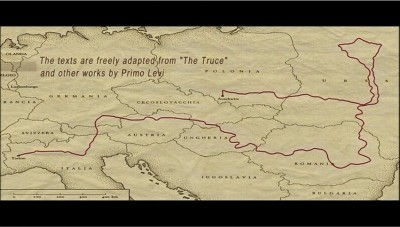
   (an "odyssey"?), filled with interesting episodes.  Apart from Poland,
   some of the places the survivors pass through include Ukraine, Romania,
   Hungary, Austria and Germany.  I've managed to find a map of the route:
     <http://www.dvdtalk.com/reviews/images/reviews/249/1219278786_1.jpg>

   Primo and his fellow survivors look forward to getting home, but they're
   unsure of what they will find when they get there.  Are they're families
   alive?

   There was a recent film adaptation, which was reasonably faithful to the
   book.

   For a more detailed summary and analysis, check out the article on the
   Italian Wikipedia:
     <http://it.wikipedia.org/wiki/La_tregua_%28romanzo%29>

Sunday, January 11

Grant Lee Buffalo - A Rough Guide

   "Combining lyrical excellence with an alternative folk sound, Grant Lee
   Buffalo forged an atmospheric texture that simultaneously evoked
   historic America and lambasted the political development of the band's
   homeland."  [BBC/h2g2]
     <http://www.bbc.co.uk/dna/h2g2/A689123>

   IMHO, Grant Lee Buffalo was one of the best (if not the best) American
   band of the 1990s.  The band was probably unlucky to have started out
   during the height of grunge.  While the band could crank up the amps
   when necessary, the music may have been too understated and the lyrics
   too deep for the era.  But the timelessness of the music should see the
   band become more appreciated in the years ahead.

   The band broke up in 1999, but the lead singer and guitarist, Grant-Lee
   Phillips, has since had a reasonably successful solo career.

   For a more in-depth history of the band, check out the official website:
     <http://www.grantleebuffalo.com/>

   The links in the guide below are to YouTube movies.  The band didn't
   release a lot of singles, and record companies seem to be actively
   having content removed from YouTube.  This is a shame, because me
   waffling on is not as an effective way of promoting the band as its
   own music is.

   The "rough guide" ...

   1. "Fuzzy"
     <http://au.youtube.com/watch?v=HAQdvw5Ot_Q>
   This is the title track and a single from the band's debut album,
   "Fuzzy", released in 1993.  This is the song that introduced me to the
   band.  A friend bought the CD when it came out and let me borrow it.
   Critics were raving about the band, and in this case I could understand
   why.  Featuring strong song-writing with simple yet powerful melodies,
   this album became one of my favourites for the year.

   2. "Dixie Drug Store"
     <http://au.youtube.com/watch?v=T8mpTiWguKo>
   This track was a bit unusual for the band, using a piano for the main
   melody line rather than guitar.  The lyrics are particularly evocative
   on this track, with the singer relating a visit to New Orleans.
   Strangely, this wasn't released as a single, so you'll have to put up
   with a simple fan-made video.

   3. "Wish You Well"
     <http://au.youtube.com/watch?v=lyQkZFi-ITc>
   Another fan-made video for a great song from "Fuzzy".

   4. "Mockingbirds"
     <http://au.youtube.com/watch?v=2-JvciQfI5A>
   This is the lead single from the band's second album, "Mighty Joe Moon",
   released in 1994.  Another simple, laid-back song, with falsetto
   choruses and a great guitar solo.  This is the official video clip,
   directed by Anton Corbijn (U2, Depeche Mode).  When it first came out,
   I didn't think the second album was as good as the debut.  But over
   time, "Mighty Joe Moon" has become my favourite GLB album.  I recently
   checked on Amazon and I'm not surprised that of 43 reviews, 40 rated
   this album 5 stars (the other three reviewers gave it 4 stars).

   5. "Lone Star Song"
     <http://au.youtube.com/watch?v=D5v16s9mA6A>
   The band occasionally gets raucous, without sacrificing melody, as can
   be heard on this song.  It's the opening track from "Mighty Joe Moon",
   and was released as a single.

   6. "Honey Don't Think"
     <http://au.youtube.com/watch?v=y6TkVRzQRDA>
   This is the video of the third single from "Mighty Joe Moon".

   7. "Rock Of Ages"
     <http://au.youtube.com/watch?v=GRstRGetBgs>
   This is the closing track on "Mighty Joe Moon".  It wasn't a single, and
   so this is another homebrew video.  There are many strong songs on this
   album, but I chose to highlight this one as it is powerful and moving.

   8. "Bethlehem Steel"
     <http://au.youtube.com/watch?v=lKWiziLLdUc>
   The band released its third album, "Copperopolis", in 1996.  This was
   arguably the band's bleakest work, with darker lyrics and themes.  The
   arrangements were becoming more sophisticated (e.g. the use of strings
   on this song).  Apparently there were tensions within the group during
   the recording, and that may have affected the atmosphere of the music.
   But it's still a very good album.  This is a live version of a song from
   "Copperopolis".

   9. "Truly, Truly"
     <http://au.youtube.com/watch?v=4ZzIHK9SWHc>
   By the time of the band's fourth and final studio album, "Jubilee", bass
   player and producer Paul Kimble had left the band.  The resulting album
   allowed a change of style, and "Jubilee" (released in 1998) is arguably
   the band's most positive and uplifting album.  This clip is a live
   version of the first single from "Jubilee".

   10. "Testimony"
     <http://au.youtube.com/watch?v=m3AtAAGvUqQ>
   This is another strong song from "Jubilee".  It looks like an official
   video, but I don't know if this was released as a single.  Unfortunately,
   the audio quality is not that good here.  I had found a better version,
   but it was recently removed for copyright reasons.

   In 2001, a two-disc compilation of singles and rarities, called "Storm
   Hymnal", was released.

Monday, December 22

The Contractually Obligated Christmas Post

   Apparently, this is the 500th post on the B-List blog.  But if you
   include email-only posts that pre-dated the blog, this is the 983rd
   B-List post.

   Best wishes for a happy and safe festive season.

   1. "Dear Economist: What's the best Christmas present?"
     <http://blogs.ft.com/undercover/2008/12/dear-economist-
        what%E2%80%99s-the-best-christmas-present/>
   "All this points to the optimal gift-giving strategy... buying small
   gifts and striving for emotional resonance. Look for something
   inexpensive, and consider supplementing it with a letter, a photo,
   or time spent together."

   2. "Researchers explain the science behind bad gift giving"
     <http://www.cbc.ca/consumer/story/2006/12/06/consumer-gifts.html>
   "Research on product attitude predictions suggests, and this research
   confirms, that familiarity with another consumer is not particularly
   helpful when predicting the other's product attitudes."

   3. "Tips From the Potlatch, Where Giving Knows No Slump"
     <http://www.nytimes.com/2008/12/16/science/16tierney.html?_r=1>
   Suggested strategies from the Kwakwaka'wakw Indians, "the world's
   most experienced gift-givers."

   4. "The scientific guide to gift wrapping"
     <http://www.newscientist.com/article/mg20026873.800?full=true>
   "Mathematicians could offer them some help because they have thought
   long and hard about how to pack things into the smallest possible
   space."

   5. Wrapping up 2008
   * 2008 Year-End Google Zeitgeist
     <http://www.google.com/intl/en/press/zeitgeist2008/>
   Based on "billions of search queries that people type into the Google
   search box."
   * The year according to Wikipedia
     <http://en.wikipedia.org/wiki/2008>
   2008 is the "International Year of the Potato", among other things.

Wednesday, December 17

Cocteau Twins - A Rough Guide

   "Cocteau Twins were a Scottish alternative rock band active from 1979 to
   1997. The band were named after the song 'The Cocteau Twins' by fellow
   Scotsmen 'Johnny and the Self-Abusers' (who later renamed themselves
   Simple Minds)."  [Wikipedia]
     <http://en.wikipedia.org/wiki/Cocteau_Twins>

   The two core members of the band were guitarist Robyn Guthrie and
   singer Elizabeth Fraser.  According to Wikipedia:
   "At times barely decipherable, Fraser seemed to veer into glossolalia
   and mouth music. Allmusic reviewer Ned Raggett writes that 'part of her
   appeal is how she can make hard-to-interpret lyrics so emotionally
   gripping.'"

   Although the band had long since broken up, I only started listening to
   its music recently.  There is that Eighties-style atmosphere, but
   Fraser's vocals sets the band's music apart and renders it timeless.
   The hard-to-understand lyrics only adds to the band's lasting appeal.
   I'm sure I could find the lyrics on the 'net, but for now I'd prefer to
   keep a little mystery.

   The band's official website:
     <http://www.cocteautwins.com/>

   The links in the guide below are to YouTube movies.  If the links
   are blocked, you can try viewing clips in Quicktime format via the
   official site:
     <http://www.cocteautwins.com/html/media/video.html>

   The "rough guide" ...

   1. "Heaven or Las Vegas"
     <http://au.youtube.com/watch?v=dtBr5JKSuks>
   I've decided to kick things off with the title track from the band's
   sixth album, released in 1990.  "Heaven or Las Vegas" is considered by
   many critics and fans as the band's best album.  It was also the band's
   biggest commercial success.

   2. "Ivo"
     <http://au.youtube.com/watch?v=ZWcgFUpypXg>
   This is the opening track from the band's third album, "Treasure",
   released in 1984.  While earlier albums had their moments, on "Treasure"
   the band was really starting to get it together.

   3. "Carolyn's Fingers"
     <http://au.youtube.com/watch?v=Qh83z5vIP0w>
   This is the music video for a single from the band's fifth album, "Blue
   Bell Knoll", released in 1988.

   4. "For Phoebe Still A Baby"
     <http://au.youtube.com/watch?v=3atilTsBoxs>
   This album track from "Blue Bell Knoll" always manages to send a chill
   up and down my spine.  Excuse the home-made fan video, but unfortunately
   there's no official video for this ethereal song.

   5. "A Kissed Out Red Floatboat"
     <http://au.youtube.com/watch?v=a5o5hVSgrK4>
   Another haunting and blissful album track from "Blue Bell Knoll".

   6. "Iceblink Luck"
     <http://au.youtube.com/watch?v=Wl5EqjtRuGU>
   This is the first single from 1990's landmark "Heaven or Las Vegas".

   7. "I Wear Your Ring"
     <http://au.youtube.com/watch?v=tkWI85aGKSs>
   Another great album track from the filler-free "Heaven or Las Vegas".
   As pointed out in one of the comments, this song combines multiple vocal
   tracks to great effect.

   8. "Bluebeard"
     <http://au.youtube.com/watch?v=DqEYJnIWgeE>
   The second single from the band's seventh album, "Four-Calendar Café",
   released in 1993.  This album is considered the most "accessible",
   mainly because Fraser's lyrics are more clearly understandable.

   9. "Oil of Angels"
     <http://au.youtube.com/watch?v=oqB0RyARUHE>
   One of my personal favourites from "Four-Calendar Café".  Another song
   that sends chills up and down my spine.  Angels indeed!

   10. "Pur"
     <http://au.youtube.com/watch?v=_0k4GPi0O-8>
   The final track on "Four-Calendar Café".  This fan-made clip has English
   "subtitles" to help the listener work out the lyrics.  I think the song
   is dedicated to Fraser's daughter.

   11. "Half-Gifts"
     <http://au.youtube.com/watch?v=ELIq96lmr-I>
   "Milk & Kisses" was the band's eighth and final studio album, released
   in 1996.  Fittingly, this is a break-up song for the break-up album.
   This is a stripped-back version from a promo video.

   12. "Seekers Who Are Lovers" (Live)
     <http://au.youtube.com/watch?v=N7ZqPaLcEQs>
   This is a live version of the last track from "Milk & Kisses".

   It wasn't easy trying to pick just 12 songs the songs from the band's
   large repertoire.  On another day I probably would've picked a different
   set of songs.

   This is a band I wish I'd known about when it was still together.  I'm
   sure I would've looked forward to each new release, wondering if it
   could top previous efforts.  Oh well, better late than never.

   Bonus tracks:
   Check out some of the Elizabeth Fraser's collaborations, for example:
   * This Mortal Coil: "Song to the Siren"
   * Massive Attack: "Teardrop", "Black Milk", "Group Four" (Mezzanine)
   * "All Flowers In Time Bend Towards The Sun", a duet with Jeff Buckley

Monday, December 8

Remixed Art and Demotivators

   1. "If other artists drew the Mona Lisa"
     <http://aviary.com/bizblog/posts/if-other-artists-drew-the-mona-lisa>


   2. "Understanding art for geeks"
     <http://gemssty.com/2008/01/28/art-for-geeks/>
   The "Mona Lisa" images reminded me of a collection of photoshopped
   masterpieces that emerged briefly start of the year, entitled
   "Understanding art for geeks".  The flickr set was removed by its
   creator before I could mention it on the B-List.  But thanks to Google
   image search, I've located some of the pics:
   * "The Scream" by Munch
     <http://www.made-in-england.org/images/the_scream.jpg>
   * "St. Matthew and the Angel" by Caravaggio
     <http://a1.vox.com/6a00c225239a5e8fdb00e398d5d0b10003-500pi>
   * "The Creation of Adam" by Michelangelo
     <http://www.valeriovalerio.org/images/god_linux.jpg>
   * "Napoleon on Horseback" by Jacques-Louis David
     <http://www.phfactor.net/wp-pics/2208736809_4df829bfc8.jpg>
   * "Waterfall" by M.C. Escher
     <http://www.valeriovalerio.org/images/water_fall.jpg>
   * "This is Not a Pipe" by Magritte
     <http://www.ecrans.fr/local/cache-vignettes/L450xH347/understanding2-
        ed7e3.jpg>

   Use this Google images search URL to dig up others:
     <http://images.google.com/images?q=Understanding%20art%20for%20geeks>

   Here's a post with an explanation why the original set was taken down:
     <http://gemssty.com/2008/01/28/art-for-geeks/>


   3. Demotivators - The Complete Collection
     <http://despair.com/viewall.html>
   The original and official set of motivational parody posters.

   Along the same lines, some unofficial demotivational posters...
     <http://www.squidoo.com/demotivator>

Wednesday, December 3

Odds and Ends, Wed 3 December 2008

   1. "Mystery piano in woods perplexes police"
     <http://edition.cnn.com/2008/US/11/23/massachusetts.piano/>
   "Was it a theft? A prank? A roundabout effort to bring some holiday
    cheer to the police? Authorities in Harwich, Massachusetts, are probing
    the mysterious appearance of a piano, in good working condition, in the
    middle of the woods."

   2. "One Woman's Story as Told by Shuffle Mode"
     <http://www.macnewsworld.com/rsstory/65330.html>
   "How much can someone tell about you by looking at what's on your iPod?
    Try this -- set your iPod on shuffle mode, then write up a list of Big
    Life Events. Each milestone gets its own randomly selected theme song,
    for better or for worse, and the result is your life's soundtrack. One
    thing it taught Amanda Deprospero: She needs to clean out her
    playlists."

   3. "Barry Manilow music used as punishment"
     <http://www.abc.net.au/news/stories/2008/11/27/2430951.htm>
   "A US judge has hailed as a success a new form of punishment for people
    who go to court for being too noisy - an hour of listening to Barry
    Manilow or the theme tune from the children's TV show Barney And
    Friends."

   4. "Merriam-Webster's Word of the Year 2008"
     <http://www.merriam-webster.com/info/08words.htm>
   "With politics and the economy foremost on the minds of many, it is no
    wonder that bailout -- a word ubiquitously featured in discussions of
    the presidency and fiscal policy -- took home honors as Merriam-
    Webster's Word of the Year for 2008."

   5. "Oxford compiles list of top ten irritating phrases"
     <http://www.telegraph.co.uk/news/newstopics/debates/3394545/Oxford-
        compiles-list-of-top-ten-irritating-phrases.html>
   "Heading the list was the expression 'at the end of the day', which was
    followed in second place by the phrase 'fairly unique'."

   6. "Life Is A Highway: Study Confirms Cars Have Personality"
     <http://www.sciencedaily.com/releases/2008/11/081125161542.htm>
   "Now a study co-authored by a Florida State University researcher has
    confirmed through a complex statistical analysis that many people see
    human facial features in the front end of automobiles and ascribe
    various personality traits to cars -- a modern experience driven by
    our prehistoric psyches."

   7. "Man petitions to marry comic book character"
     <http://www.abc.net.au/news/stories/2008/10/30/2405987.htm>
   "A Japanese man has enlisted hundreds of people in a campaign to allow
    marriages between humans and cartoon characters, saying he feels more
    at ease in the 'two-dimensional world.'"

   8. "The Matrix Runs on Windows"
     <http://www.collegehumor.com/video:1886349>

   9. "Star Wars Vs. Star Trek"
     <http://au.youtube.com/watch?v=v4ijDlbvAxw>